| visit: www.infertilitytutorials.com |
|
Progesterone Concentration
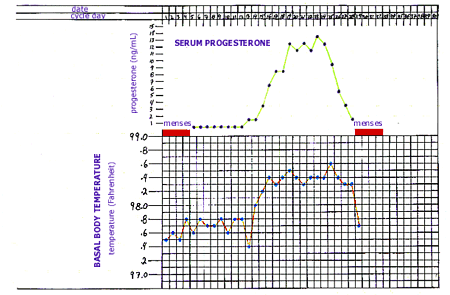
Progesterone concentration in the blood increases dramatically after ovulation. Obtaining a single random (or multiple) serum progesterone concentration(s) during the post-ovulatory phase of the menstrual cycle is often able to confirm the usual “post ovulation” rise in circulating progesterone. Progesterone concentrations are pulsatile in the post ovulatory phase of the menstrual cycle. Therefore, it is possible to obtain a progesterone concentration that is “lower than expected” with single random samples since one might catch the nadir (low point) of a pulse. The progesterone concentration that suggests that ovulation has occurred is controversial, with many Reproductive Endocrinologists using progesterone concentrations in excess of 3-4 ng/mL to signify a luteal phase level. Progesterone concentration is usually less than 1 ng/mL prior to ovulation. The progesterone concentration does not allow one to determine the time that ovulation occurred, rather simply that ovulation has occurred. “Luteinized Unruptured Follicle Syndrome” (LUFS) is a theoretic (hypothetical) possibility, implying that an ovarian egg containing cyst (follicle) became luteinized (among other things, to primarily produce progesterone rather than estradiol) at the time of “ovulation” yet did not release the mature egg (the follicle did not rupture to release the egg into the pelvis). In this situation, progesterone concentrations would be elevated yet the egg may not have been released. It is not clear that LUFS really occurs, with many Reproductive Endocrinologists believing LUFS to be extraordinarily rare or nonexistent.
| |||||||||||||||