| visit: www.infertilitytutorials.com |
|
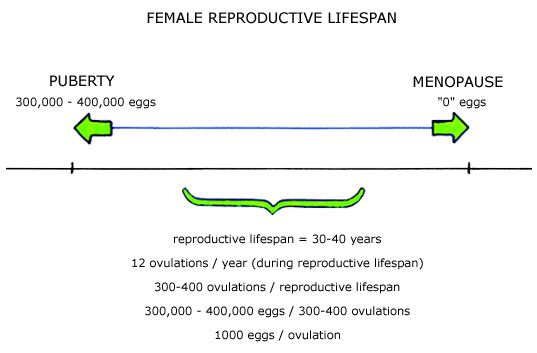
A (human) female is born with all of her eggs, which are contained within the ovaries. At birth, there are roughly 1 to 2 million eggs. At puberty, there are only about 300 to 400 thousand eggs remaining within the ovaries. At menopause, there are (generally) no eggs capable of maturation and ovulation. Therefore, during a normal reproductive lifespan (from puberty to peri-menopause) 300 to 400 thousand eggs are “used.” A normal reproductive lifespan may extend from puberty (12-13 years old) to peri-menopause (40-50 years old), which includes a 30-40 year time period. Normally, a reproductive age woman has monthly ovulations (and menses) so that there are 12 ovulations per year. Therefore, a normal reproductive lifespan may include 300 to 400 ovulations. Since 300 to 400 thousand eggs are used in 300 to 400 ovulations, a (human) female uses on average about 1000 eggs per ovulation. In other words, for every one mature egg that ovulates during the reproductive years a thousand eggs (on average) become degenerate (deteriorate). If a woman “uses up” her eggs more rapidly than normal she will “run out” of eggs (enter menopause) earlier while if she “uses up” her eggs more slowly than normal then she will “run out” later. The factors that determine the rate at which a woman uses her eggs are not fully known, but do appear to involve specific genes present on the X chromosome. Therefore, there is often a family (genetic) tendency that predicts when menopause will occur (a woman may have later menopause if her mother and grandmother had later menopause). When a couple goes to a fertility doctor for an evaluation of subfertility, one of the earliest tests that may be suggested is an assessment of ovarian reserve (the number of eggs remaining within the ovaries). These tests generally involve bloodwork performed at a particular time within the menstrual cycle (discussed in detail in this tutorial under causes of ovulation dysfunctions). | |||||||||||||||