| visit: www.infertilitytutorials.com |
|
Vaginal and Salivary Electrolytes
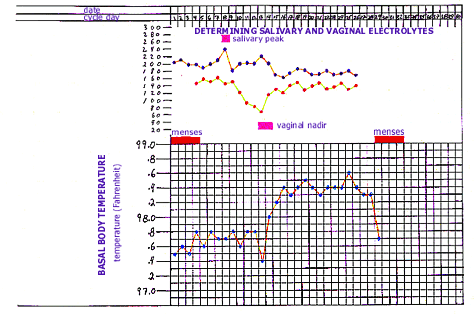
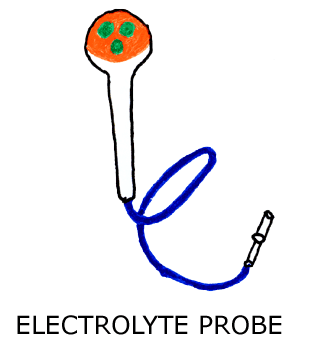
Electrolytes in the saliva (of the mouth) and the fluids within the vagina undergo changes throughout the menstrual cycle. Monitors that detect electrolyte changes in these fluids are commercially available, using a spoon sized sensor that is placed on the tongue for about 8 seconds (with the test result being a number that is displayed on the monitor) and another sensor the size of a tampon that is placed into the vagina for about 8 seconds (with the test result also being a number displayed on the monitor). The electrolyte readings from the tongue appear to peak around 6 days prior to ovulation (pink square on graph). The electrolyte readings from the vaginal probe have a nadir (low point) followed by a “sharp rise” of greater than 20% after ovulation has occurred.
Sperm travels through the human female reproductive tract very rapidly, and can be found in the fallopian tube within minutes of either intercourse (sex) or insemination. Therefore, the advantage of a 6 day “warning” that ovulation will occur as opposed to a 1-2 day warning (with urinary LH monitoring) is unclear. The suggestion that human sperm requires several days to traverse the female reproductive tract is not the usual medical understanding. Also, the salivary electrolyte monitor readings have a normal variability such that the “peak” may be impossible or difficult to reliably detect (since the peak value is not much greater than any other “normal” value). In my infertility practice, I have not encountered anyone who uses the electrolyte monitor for ovulation prediction. The monitors may be more popular in other parts of the world. Additional research would be interesting to determine the clinical value of these monitors.
| |||||||||||||||